
Joshua 3:10 (excerpt) and Joshua 4:6-7
By this you shall know that the Lord the living God is in the midst of you…and when your children shall ask you tomorrow, saying: What mean these stones? You shall answer them: The waters of the Jordan ran off before the ark of the covenant of the Lord, when it passed over the same: therefore were these stones set for a monument of the children of Israel for ever.
“Sir?…Sir!!“… The sense of urgency and increased dynamic level of the second ‘Sir!!‘ accomplished its intended purpose, breaking me free from the frozen state of shock that had so fiercely seized my heart as I listened to the state trooper on the other end of the phone ask, with no preface or explanatory context other than the intensity of her voice, “Sir, was there a child in the car with your daughter?!”
I had heard the question clearly enough the first time and what it told me I did not want to accept, though I had deduced the circumstance of its asking quickly enough: 1) An experienced state trooper, upon finding an empty car seat at the scene of an accident, thought it possible that a small child could have been thrown to such a distance from the vehicle so as to be yet unfound by first responders, disclosing to me instantly that the initial vehicle impact must have been horrendous. 2) The trooper was asking me about the child, confirming that my 18-year-old daughter, Olivia, was not in a condition to answer for herself.
“No…No, her…her son is with me. I’m watching him today,” I stuttered. Then, questioning my normally firm grasp of reality, I scanned the room in near panic looking for Isaiah before settling my eyes immediately downward upon the 14-month-old child playing happily at his grandfather’s feet. The state trooper responded to my answer with a clear sense of relief in her voice, “OK, (audible breath release) we had to make sure. We found an empty car seat thrown about forty feet from the vehicle. Sir, your daughter has been in an accident.”
Tuesday afternoon, September 2, 2008 – It was the phone call every parent dreads, and I was no different. There was silence now on the line and I knew I was being allowed a moment for the news to sink in. Finally I asked, afraid to hear the answer, “How…how is she?” The quiet pause on the other end of the line was long and agonizing as the empathetic female state trooper considered how to frame her response. My body began to tremble. Then came the carefully worded reply, “She was conscious when they put her on the helicopter.”
Thirty minutes prior to that call, first responders had just begun arriving at a crash site in rural Greene County. They made a rapid assessment of the scene. A blue Chevy Lumina, traveling downhill at a high rate of speed in the rain, had missed a sharp left turn. The vehicle left the roadway and went airborne, striking the base of a large tree which stood 30 feet from the edge of the asphalt – head-on, offset driver’s side – at an estimated speed of 50 miles-per-hour. The force of the impact instantly turned the 3500-pound car into a mangled hunk of steel and sent it ricocheting off to the right where it spun and slid another 40 feet before coming to rest in a grove of young saplings. The aged tree that had absorbed the impact remained unmoved, though a large piece of it was torn away from the trunk, strewn about in shards on the ground nearby.
The driver’s seat of the Chevrolet occupied the area that had once been the back seat and, pinned between the contorted steering wheel and the driver’s seatback, was the smashed and maimed body of a slight – maybe 110 pound – teenage girl. Her left thigh was broken over at a grotesque 90 degree angle as a result of a femur that had been snapped in half by the force of the engine pushing its way into the driver’s compartment. Her chest was crushed. Internal injuries were obviously massive. Head trauma was severe. The young girl’s head and chest had impacted the steering wheel so violently and with such force that they had bent the wheel as if it were a soft pretzel. The airbag in the center of the steering wheel remained intact, having failed to deploy.
A Logan-Rogersville Fire District firefighter arrived first to the scene and checked the driver for a pulse. There was none. He checked for respiration – nothing. The girl would have to be extricated from the tangled wreckage with cutting tools but, for the moment, time was of the essence. He knew if he could relieve the pressure on her collapsed chest there was a chance – it had been known to happen – that she could be resuscitated. He worked furiously with bare hands to break loose the firm seatback. Suddenly it gave way and he heard a violent gasp of breath and, in the corner of his eye, he saw a flattened chest partially re-inflate.
A cold rain was falling. Visibility was poor. The firefighter knew it would be difficult, maybe even impossible, to get a medivac pilot to risk flying in these weather conditions for a victim that was clearly not going to survive. The injuries were just too severe, the body too broken. But hope often hangs on the thinnest of threads, and this young girl was still clinging to life – that was reason enough to try.
In 2008 St John’s Hospital in Springfield had the only Level 1 trauma center in Southwest Missouri. Though the medivac chopper was owned and operated by a competing hospital, the Vietnam-era pilot that flew it knew exactly where he needed to deliver his cargo. It was a nasty, rainy day and other pilots had refused to go up, but he took the call, as men of that caliber always do. The Logan-Rogersville firefighter at the accident scene who requested him knew if there was anyone who would go up in this weather, it would be the combat veteran. He had flown in conditions far worse than this. At least he wasn’t dodging ground fire.
I kept the conversation in the car as mundane as possible and consciously drove the speed limit as we traveled to the hospital emergency room. When I had called Rebecca at work to tell her I was coming to pick her up I intentionally withheld critical details of the phone call I had just received. She knew only that Liv had been in an accident and was being transported to St John’s. I knew my wife would not question me about it, relying rather on her considerable ability to read my body language and facial expressions to determine the magnitude of the situation. I disguised them as best I could. I did not want her to know my deepest fear – that our little girl might not be alive when we got there.
The receptionist’s chair at the ER check-in counter was pushed away and empty when we arrived. The large waiting area to the left of the counter appeared empty as well. For a moment we stood there alone, Rebecca with a loose grip on my right upper arm, me clamping Isaiah to my left hip with the other arm and both hands. Perhaps it was the ‘aloneness’ of that moment that brought it on – a sudden feeling of desperate foreboding, the unthinkable feeling one might imagine would take hold of a passenger on an airplane as it plunged earthward after being disabled by some sort of mid-air calamity. I wanted to leap the counter and run to the patient area – to find my daughter and tell her I was there and that I could make it better, though I knew I could not.
My dread gave way to a sense of urgency as a nurse emerged from a nearby hallway. Now I had a mission. I approached her quickly. My words were spoken quietly in an attempt to veil from my wife the apprehension that now held me in its grip. “I was told our daughter was brought here after a car accident?” I spoke calmly, intonating the indicative statement as if it were a question.
The nurse squinted her eyes and shook her head slowly. “No, we haven’t had any car accidents come in today,” she said as she moved towards a desktop keyboard, intending, I assumed, to tap in a name and send us off to the nearest patient information desk. I gave her our last name.
“They brought her in by helicopter,” I said, almost in a whisper. The hand that had been loosely gripping my right arm suddenly cinched tight.
The nurse froze for a moment. “Oh, yes.” Her previously distracted expression had now transformed to one of grave concern. “Follow me, please.” She led us down a hallway to a small room. The sign on the door said ‘Chaplain.’
“You didn’t tell me there was a helicopter.” My wife whispered through trembling lips, barely able to exhale the words – the weight of a mother’s breaking heart was audible in each spoken syllable. I stared silently at the floor. “No, I didn’t tell you about the helicopter,” I thought to myself. “I didn’t want you to know about the helicopter.”
When the St John’s chaplain arrived at the small waiting room she was all smiles and small talk – polite introductions, ‘how are you’, ‘what a cute little boy’, etc. – no mention of the accident, of our daughter, of our whole reason for being there. Over the course of the next twenty minutes she popped in and out of the room, returning, it seemed, only to revisit whatever ridiculously inane topic she had been chatting about when last we saw her. A few more minutes in the room and off she would go again, for no stated reason.
The entire scene would have seemed absolutely surreal if not for the fact that I understood the strategy, and more importantly, that which its employment revealed. We would not have been in this room with the ‘Chaplain’ sign on the door if hospital personnel had been expecting Olivia to survive. At the same time I knew that if my daughter had passed away they would waste little time in notifying us. This was a classic stall for time. I viewed it as a glimmer of hope and was content to ride it out. After twenty minutes, my wife was not. “Ma’am, I need to know what is going on with my daughter!” The pleading tone of Rebecca’s voice seasoned with angry impatience caught the female chaplain off guard.
A genuine sadness suddenly betrayed itself beneath the previously restrained ‘chaplain’ demeanor. I felt sorry for her. Could any job be harder than the one she had at this very moment? “Let me see what I can find out,” she said quietly. “We have not made a positive identification yet.” The sudden gravity in her voice tore at my heart.
The chaplain left the room and returned shortly with a nurse who appeared to have some level of authority. She was holding something in her hand behind her back. Knowing which of us would most likely be able to answer her question, the nurse looked at my wife and asked softly “Can you describe the belt and buckle that your daughter was wearing?”
Rebecca nodded her head slowly and described a belt buckle with a unique design that apparently was one of Olivia’s favorite accessories. The nurse opened her hand and displayed a buckle that matched Rebecca’s description exactly. “I’ll consider that a positive I.D.” she said as she and the chaplain turned and left us alone again in the small room. I concluded that the belt and buckle must have been the only articles on Olivia’s person that were not stained with blood.
Within a few minutes the chaplain returned and we were told we could visit our daughter in the ER treatment room, but not before the head nurse attempted to prepare us for what we were about to see. There was nothing she could have said that would have prepared us sufficiently. Olivia was unrecognizable. Her face was swollen and bruised. There was a long row of stitches above her left eye. She had a tube down her throat and a large brace around her neck. Wires and IV tubes were attached at various places on her arms and upper torso. There was a tube coming out of her side to drain fluid from her chest cavity. She was not conscious. I touched her arm. There was no response. The only signs of life were the warmth of her skin and the rhythmic blinking lights of the vital-signs monitor.
Three nurses stood off to the side in the shadows behind the bright, portable operating lights. They were leaning silently against a counter, alternately watching us through somber, tender eyes and then avoiding eye contact altogether by shifting their gaze to the floor near their feet. The scrubs they wore appeared to be stained. Surgical masks were hanging loosely around their necks revealing solemn faces that had witnessed this same scene play out far too often, at different times and with different casts of characters. Though they appeared spent, it was not the fatigue of physical exertion that showed forth so much as a kind of resignation – a resignation perhaps to the emergency medicine reality that no matter how hard you try, you will not save every patient that comes through the ER. I noted too much sadness in their faces to think that they were optimistic about the future of this patient.
We were allowed about five minutes with our daughter before she was quickly removed from the ER and wheeled to an operating room. It was critical, we were told, that the shattered femur be surgically repaired with a titanium rod as soon as possible. The risk of a razor-sharp piece of bone severing the femoral artery was extremely high. What we were not told was that, in combination with her other injuries, such an occurrence would not have been survivable.
Even with the surgery, Olivia’s odds of survival were extremely slim. The rundown of injuries was extensive. In addition to the shattered femur she had swelling on the brain due to blunt force trauma to the forehead, a possible fractured skull, a seriously lacerated liver, a bruised and damaged heart that was barely functioning, multiple broken ribs, one lung punctured, the other lung fully collapsed, a broken ankle, a broken hip, spinal and neck injuries of as-yet unknown magnitude, and multiple cuts, bruises, and soft tissue injuries. She required a ventilator in order to breathe.
The full list of injuries was not immediately revealed to us – wisely I suppose, as I’m not sure we could have handled it. Instead the medical staff focused on the femur surgery. It was something they could fix right now. Everything else fell in the ‘need-to-know’ category. None of it would matter if she did not survive the night.
The surgery was completed successfully that evening and Olivia was moved directly to the St John’s Neuro-Trauma Intensive Care Unit and listed in ‘guarded’ condition – which is a deliberately vague term used when the outcome is in doubt. That was late Tuesday evening, approximately six hours after the accident. It was unknown to us at the time but became evident later that the Intensive Care medical staff was not expecting her to leave their unit alive.
For the next 36 hours, Rebecca and I lived in the ICU waiting room. The intensive care unit itself occupied a large circular space that was set up like a wheel with a central command center at the hub and fifteen small patient rooms surrounding it on the perimeter. The only public access to the unit was through two sets of double doors that were always locked except during posted visiting hours. There were four such designated periods each day. Their duration was sixty minutes. The times were strictly adhered to and only two people were allowed in the room at any one time. Those visiting hours were the only times we were allowed to be in the ICU patient room with Olivia.
Our first ICU visit was at 6 AM Wednesday, the morning after the accident. Olivia’s appearance had not changed since we saw her in the ER the previous evening. She was still hooked to the same machines and tubes, still intubated and breathing with a ventilator, face still battered and unrecognizable. She appeared to be heavily sedated. Her eyes would open occasionally but it was difficult to say whether she recognized us. While we were in the room with her the ICU medical staff kept themselves at a distance. Their averted eyes gave me the strong impression, for the second time in as many days, that we were being allowed time alone with our daughter to say goodbye.
On Wednesday afternoon I drove alone to the accident site near Rogersville. The tire impressions that marked the place where Olivia’s car had left the road were still visible, as were the plowed-earth furrows that marked the path the vehicle took after it ricocheted off the thick tree that stood as the single sentry of age on a gently sloping hillside otherwise dominated by a younger and much more pliant generation of seedlings. The scar on the side of the old tree was fresh and still green. I touched it, needing for some reason to confirm that it was real.
I stepped back to a distance from which I could take in the entire accident scene in a single field of vision – starting on my left from the point where the car left the road and sweeping in a clockwise arc to the spot where it came to rest on what was now a patch of turned-up rocky soil. The solemn, scarred tree stood midway between the two points. The evidence of what had taken place the previous afternoon was laid out before me in a single vista.
I stood and stared, for how long I don’t know, imprinting the scene into my memory. I did not know at that time how things would work out – whether Olivia would live or die, whether or not Rebecca and I would end up raising our grandson, how I would guide my wife through the despair of losing a child, if that should be the outcome. I had no answers to any of these questions. Yet, in spite of the sadness these unknowns brought to my heart, and regardless of what the future held, I felt confident in this one thing: that my God would work this situation out for good and for His glory. Of this I was certain; and, for those future occasions in which my courage may for whatever reason begin to fail, I wanted to be sure that I remembered the confidence of that moment.
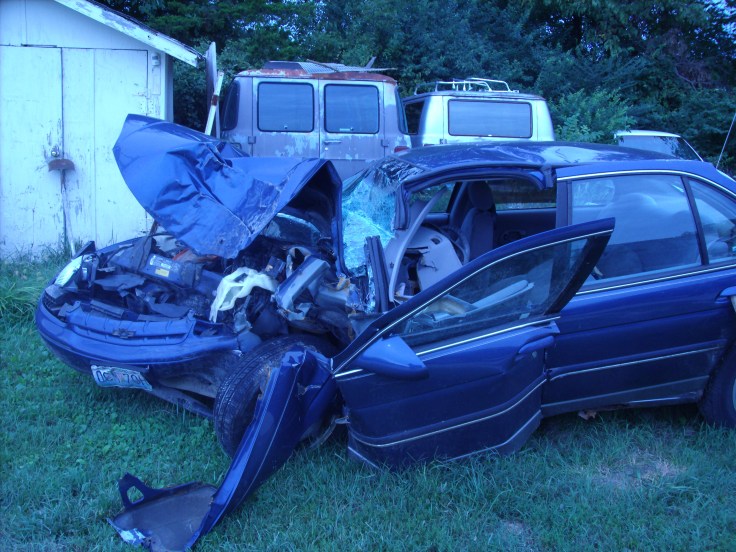
When I left the accident site I drove on to Rogersville, to the scrapyard where I knew the car had been taken. I felt the color drain from my face when, from the highway, I first caught site of the tangled, blue mass of steel sitting in plain view behind a barely-upright metal building. I parked on a gravel drive nearby and walked slowly towards the maimed vehicle.
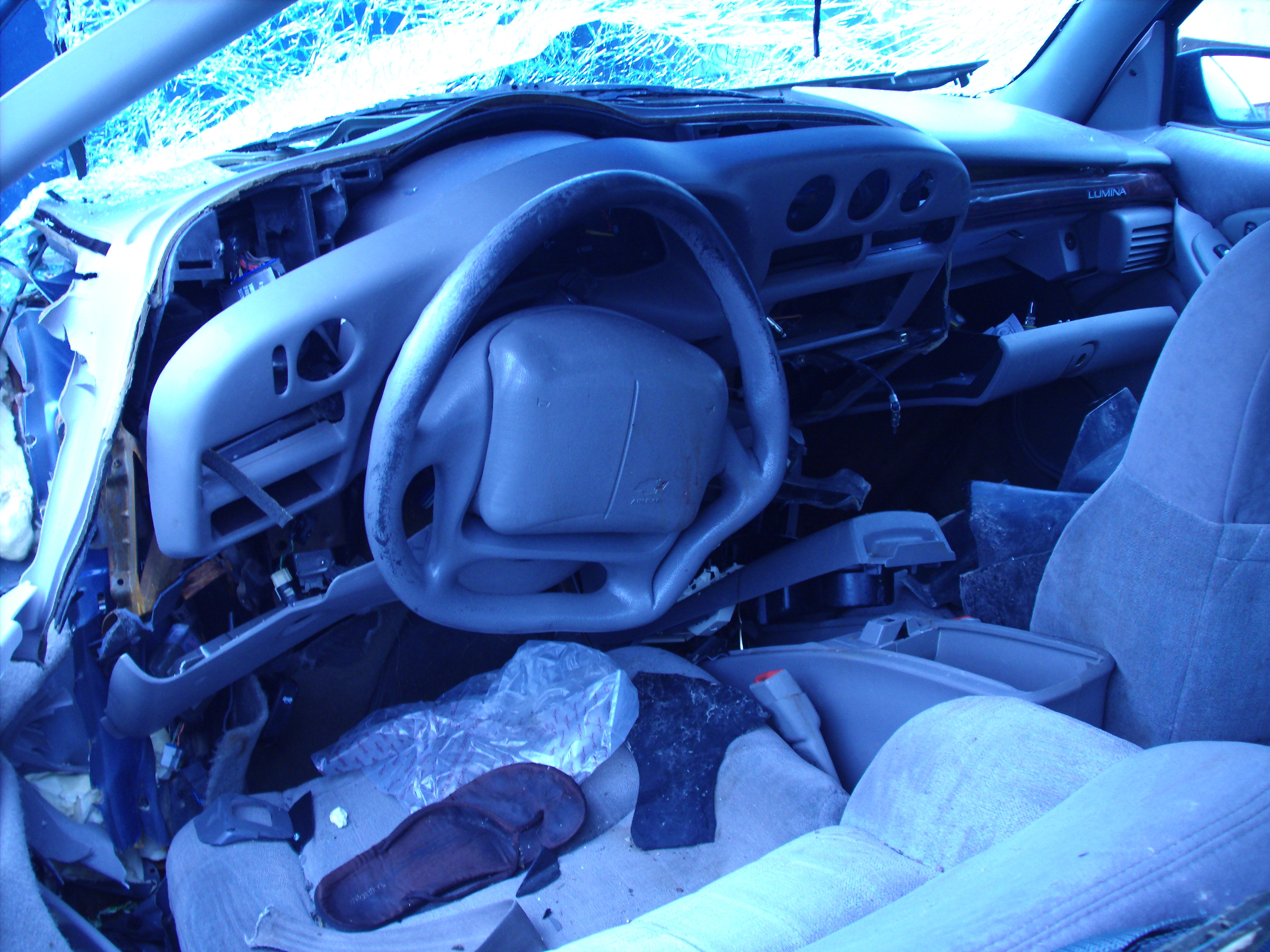
As I approached, my gaze became focused on the steering wheel – bloodstained, bent, and disfigured by the frail body of my little girl. How could she possibly survive an impact that could contort a steering wheel like that? I circled the car and took several pictures. I’m not sure why.
When I was finished I walked to the scrapyard office, signed over the title, and sped back to the hospital. I did not want to miss the next visiting hour.
That evening during our church’s Wednesday night prayer meeting, the pastor encouraged those present to get on their knees and pray for Olivia. When the service dismissed a group of thirty or so church members drove directly to the hospital, filling the ICU waiting room and spilling over into the hallway. It was the final visiting hour of the day. Olivia was awake and seemed a little more alert than she had been up to that point. I asked her if she wanted to see some visitors from church. She seemed to understand and nodded her head weakly. The ICU staff turned a blind eye to the posted rules as I began to send people in to see Olivia, four at a time. They all spoke to her, encouraged her, and told her they were praying for her. Liv still had a tube down her throat connected to a ventilator that did her breathing for her, but I was nearly certain I saw her eyes smiling.
At 6 AM the next morning, Thursday, Rebecca and I were standing in the hallway outside the ICU listening for the clicking sound that would indicate that the double entry doors were being unlocked for the first visiting period of the day. The locks clicked right on schedule. We passed through the first set of doors, down a very short, narrow hallway, and through the second set of doors into the command center hub and were immediately met by a doctor who had been waiting there for us. I felt my chest tighten as I moved closer to my wife. If this was bad news I needed to be in a position to catch her when her knees buckled.
“Your daughter turned a corner last night.” He spoke quietly and matter-of-factly with a familiarity that assumed we knew that he was the doctor in charge of Olivia’s care. I had never set eyes upon him prior to that meeting.
“She still has a long way to go and she is not out of the woods yet, but I think I can say now that I am guardedly optimistic. I could not have said that before this morning.”
His words hung there in the air like smoke from a burning pile of leaves on a cold autumn morning. This mystery doctor’s statement had just confirmed what all of the non-verbal indicators up until that point had suggested – that no one involved in the care of our daughter since the accident had expected her to survive. It was a lot to take in – ‘not out of the woods,’ ‘a long way to go,’ ‘guardedly optimistic’ – the fact that these were the phrases used to describe an improved prognosis spoke volumes about the gravity of the initial assessment.
Apparently, now that Liv had improved to the point that her doctor thought she might actually pull through, he had decided it was appropriate to begin to fill us in on his evaluation of both her current situation and her future extended care. He told us that the next step short term was to get her off the ventilator – a two to three day weaning process that could begin as early as the following week if her lungs continued to heal.
For the long term, he thought it was possible, maybe even likely, that Liv would never fully recover. Head, spinal, and neck trauma could result in mobility issues, speech issues, and even mental comprehension issues that could leave her dependent on daily medical care for the rest of her life. Even if a full recovery were possible it would be at least a year down the road. Transporting Olivia to daily sessions of physical therapy and brain injury rehab would become our new normal.
After 36 hours of intentional ambiguity, this blunt candor hit us like a punch in the gut. It was a lot to process, but at least we now had an idea of what we were facing. Nevertheless, the reality of what Olivia’s future held was heartbreaking for both my wife and myself. The rest of the day passed in a fog as we each dealt with this new reality in our own unique ways.
Rebecca and I had become an established presence in the ICU waiting room. The steady stream of visiting family and friends throughout the day was a welcome distraction for my wife, who is naturally personable and outgoing. True to my own reserved nature, I spent the day quietly hidden in a corner of the ICU waiting room. Lost in my own thoughts, I begged God for strength and, if it might possibly be His will, I pleaded for a miracle.
The drive home Thursday evening was silent, the revelations of the day still too painful to talk about. Sleep was welcome. In seven hours we would be back again at the ICU, waiting for the 6 AM click of unlocking double doors.
Rebecca and I were up well before dawn the next morning in order to make it back to the hospital in time for the early morning visiting hour. From the kitchen I heard a muffled sob and the sound of something hitting the floor. I ran down the hallway to the bathroom. Rebecca was lying on the floor crying inconsolably. The weight of the week’s events, consummating with the sobering revelations of the previous day, had finally become too much for her. I gathered her up in my arms and held her tight, rocking her back and forth as I would a small child. I have never felt so helpless as I did that Friday morning.
Somehow, driven perhaps by the irrepressible instinct of motherhood, Rebecca found the strength to finish getting ready and by 5:45 I was pulling into what had become our customary space on the St John’s parking deck. The sun had not yet risen as we made the long trek from the deck and across the mostly empty parking lot to the hospital entrance. I held my wife’s hand firmly. Her eyes remained moist. She was trying her best to hold back the sobs. As we made our way through the darkness she asked me softly, almost pleading, through tears and with a trembling voice, “Will things ever get better?”
What happened next was pretty much the equivalent of a pink unicorn sighting. I began to sing – out loud and in public. Rebecca and I loved a Southern Gospel group called The McKameys. They toured regularly through Springfield and we had gone to see them several times. The McKameys had a song called ‘Somehow He Will’ and right there in the middle of the St John’s parking lot I began belting out the chorus, “I don’t know how God will make things go better. I just know that somehow He will.”
Rebecca suddenly laughed out loud. Not so much at my singing, which I’m sure was awful, but just at the fact that her quiet, non-verbal husband would be singing out loud at all, much less in a public place at zero dark-thirty in the morning. I guess you could say it was out of character. But the fact is, the words that I sang expressed exactly what I firmly believed then as well as now, and not because of the song or because of a feeling, but because I had spent enough time in the Word of God to know that the lyrics spoke the truth.
My wife was still smiling, albeit with tear-stained cheeks, when we arrived at the ICU entrance – just in time for the 6 AM clicking sound of unlocking doors. Though it seemed an eternity, it had been just 60 hours since Olivia had arrived at the St John’s ER on the medivac chopper. It had been the most trying 60 hours of my life. As soon as we entered the ICU command center hub, a nurse came running toward us. My grip on Rebecca’s hand instinctively tightened.
“Your daughter is doing a lot better this morning!” The nurse was visibly excited as she slowed to a more hospital-appropriate fast walk. “You won’t believe how much better she is!”
Rebecca and I rushed to the open isosceles-shaped patient room where Olivia had spent the last two-and-a-half days. Her eyes were fully alert and I could even detect a hint of a smile behind the breathing tube that had been keeping her alive since Tuesday.
During that morning visit the head nurse on duty filled us in on Olivia’s updated condition. She said that Liv had improved so much overnight that they thought they could begin weaning her off the ventilator. That process would take a few days. Once off the ventilator they could do an MRI to assess the neck and spinal damage and then begin to consider moving Liv out of the ICU and into a private room. Overall they were hopeful that within two weeks, if all went well, Olivia would be out of intensive care and into a regular room. The expectation was that her stay in a private room would be at least an additional month, consisting of intensive physical therapy and brain trauma rehab. This was all wonderful news, but it wasn’t what happened.
The next visiting hour was at 11 AM. When Rebecca and I walked into Olivia’s room at 11:00 she was off the ventilator, the neck brace was gone, and she was sitting up in bed eating her lunch – unassisted, and she ate it ALL. The MRI had already been completed. It revealed no damage to her neck or spine. Before the next ICU visiting hour rolled around Olivia was being wheeled out of the ICU and into a private hospital room!
The next day, Saturday, the doctors were still telling us that Olivia would be in a regular hospital room for an extended period – at least a month, perhaps more. After that she would go through a year of daily outpatient physical therapy, breathing therapy, and brain trauma rehab.
Five days later, on Thursday, Olivia was discharged from the hospital and sent home. It had been just nine days since the car accident – an accident she had not been expected to survive. But that wasn’t the end of it.
The following Monday I drove Rebecca and Liv to the therapy center that had been recommended to us by the hospital. For Olivia’s initial appointment they would do an assessment and then set her up on a rigorous daily schedule. At best, Liv was not expected to be fully functioning for at least a year. Rebecca was going to have to quit her part-time job as a church secretary so that she would be free to take care of Isaiah and to transport Olivia back and forth to therapy each day along with caring for her at home when Liv was not at rehab.
Even with insurance, I knew that the daily therapy would cost me a fortune and I had no idea how I would pay for it, but it had to happen. Olivia had come so far already. The first session was going to take a few hours so I dropped Liv and Rebecca at the rehab facility on South National while I kept Isaiah and ran some errands. When I came back to pick them up they had just finished the session and were on their way out.
“So what is her schedule going to be from here on out?” I asked my wife, already trying to work out the logistics of daily 10-mile trips back and forth to the rehab center. I was more than a little stressed.
“They didn’t give me a schedule,” she said.
“What do you mean, they didn’t give you a schedule? I have to….” Rebecca cut me off.
“She doesn’t need to go back.” Seeing the consternation in my face, Rebecca paused briefly to allow her words to sink in. “They said she is already doing better than most people who have been in the program over a year.”
I wasn’t sure I had heard her correctly. “She doesn’t have to go back? Ever? No rehab at all?”
“That’s what they said.” Rebecca appeared to be as stunned as I was.
“Hereby shall ye know that the living God is among you… ”
Joshua 3:10A
When the time came for the children of Israel to enter the Promised Land they faced an enormous obstacle. They needed to cross the Jordan River which, at any other time of the year, would not have been a challenge as there were normally accessible shallow fords available for crossing. But it was springtime and the river was at flood stage – flowing deep, fast, and possibly as much as a half-mile beyond its banks on either side. It was an impossible barrier for a nation of two million men, women, and children.
God told Joshua to send priests bearing the ark of the covenant into the river. As soon as their feet touched the water the river began to ‘rise up upon a heap’ at the city of Adam, 18 miles upstream. The wall of water was so high that the Israelites could see it from 18 miles away. The water that remained in the riverbed ran off to the Dead Sea.
“And the priests that bare the ark of the covenant of the Lord stood firm on dry ground in the midst of Jordan, and all the Israelites passed over on dry ground, until all the people were passed clean over Jordan.” Joshua 3:17 KJV
God then gave Joshua instructions to set up a memorial as a reminder to Israel of this incredible miracle. While the priests bearing the ark remained in the center of the dried-up Jordan, He told Joshua to send twelve men, one from each tribe, back into the riverbed. Each man was to shoulder one large stone from the center of the river and bring it back to Joshua. Joshua then had the priests complete their crossing with the ark. As soon as they stepped out of the river the water returned and flowed over its banks as it had before.
Joshua stacked the stones in a pile at Gilgal, on the west bank of the Jordan River. That heap of twelve slick-smooth river rocks stacked up in the midst of the rough and rugged terrain north of the Dead Sea near Jericho could not have been any more out of place. But that was the point. There was nothing spectacular about the monument itself, but the unusual sight of those ‘out-of-place’ rocks would inevitably provoke questions regarding their origin – “What mean these stones?” – thus the memory of an event that openly displayed the undeniable power and glory of God would remain alive and relevant for future generations.
And those twelve stones, which they took out of Jordan, did Joshua pitch in Gilgal. And he spake unto the children of Israel, saying, When your children shall ask their fathers in time to come, saying, What mean these stones? Then ye shall let your children know, saying, Israel came over this Jordan on dry land. For the Lord your God dried up the waters of Jordan from before you, until ye were passed over, as the Lord your God did to the Red sea, which he dried up from before us, until we were gone over: That all the people of the earth might know the hand of the Lord, that it is mighty: that ye might fear the Lord your God for ever.
Joshua 4:20-24 KJV
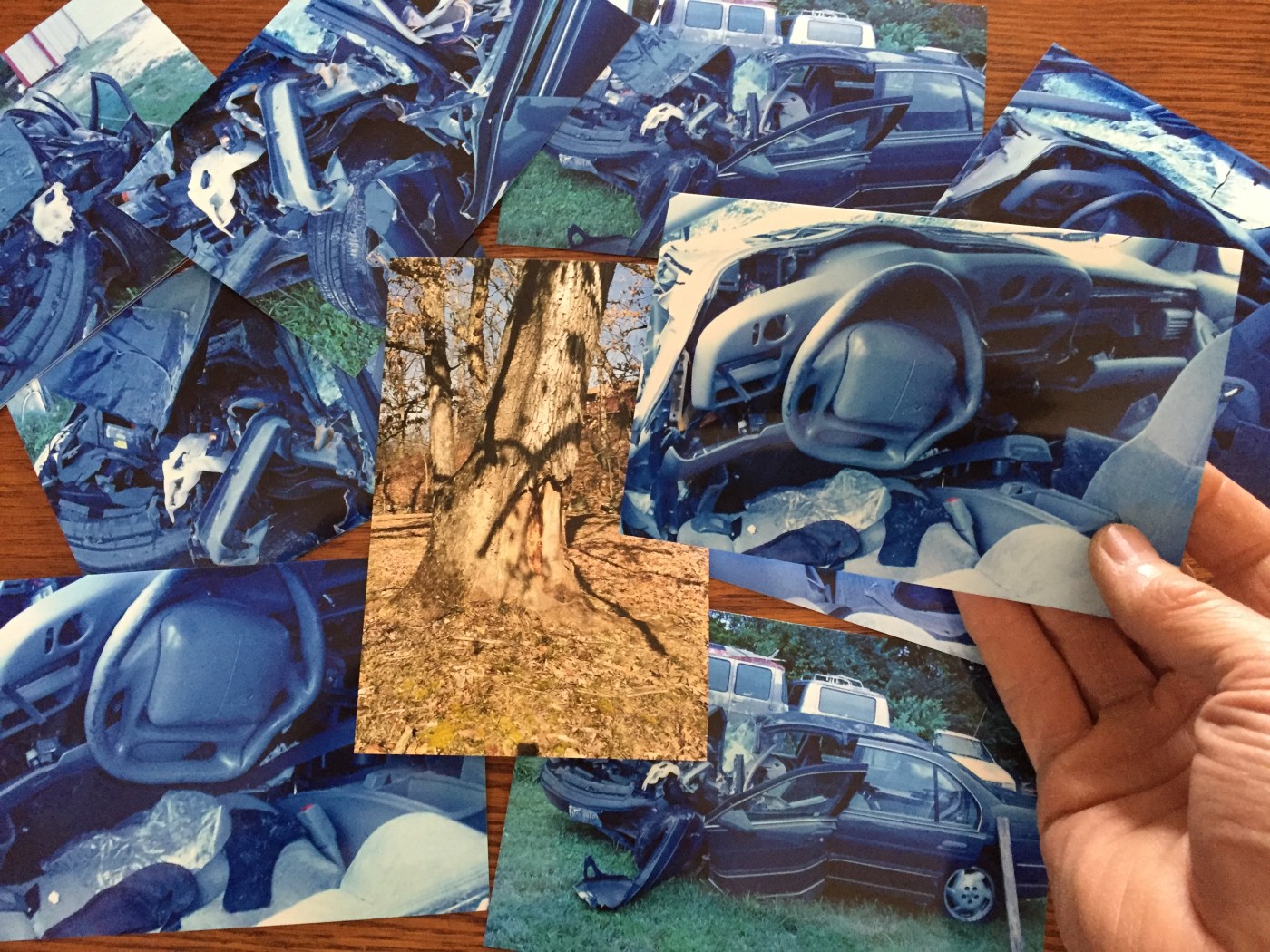
A few weeks ago I was doing research for an unrelated writing project when some pictures in a folder on one of my bookcases caught my eye. They were the photos of the wrecked Lumina that I took at the scrapyard the day after Olivia’s accident, along with a photo of the scarred tree that I had taken some time later. I spread them out on the coffee table in our living room and stared at them for several minutes.
As I poured over the photographs in front of me, all the memories from that 2008 accident began flooding back, details that I had not thought about in years – both the heartache and the incredible circumstances of Olivia’s recovery that would lead so many people who are familiar with the story to refer to it as a miracle.
It was a time when God clearly and unequivocally made Himself known to us – to my wife and me – in a manner which seemed to defy natural explanation. And yet, I had begun to forget that extraordinary occasion in which the living God actively demonstrated that He was in our midst! How could I have let that happen?
We humans are like that. We are forgetful creatures, easily distracted by the cares of the world, and gravely in need of constant reminders regarding the things and events to which we should attach the greatest value and significance. I am thankful that we have an omniscient God, One who can be neither surprised nor disappointed by anything we do. By His providence and by His tender mercies He makes accommodation for our weak-mindedness by providing us, His children, with special reminders of His goodness, mercy, grace, and power.
He furnishes us with things that spark our memories, like piles of stones, or maybe even photos of a wrecked car taken ten years ago, not knowing why I was doing it – ever-faithful reminders of His presence and His power, that His hand is mighty and that He is able – gracious reminders of those times when He carried us through a fiery trial and delivered us to a more enduring faith: “By this you shall know that the Lord the living God is in the midst of you…”
We need those memorials. We need to cling to them as reminders, reminders that our God is Jehovah-jirah – the ‘God Who will provide.’ They are mercies from a loving Father intended to help sustain us through the severe trials of life, for those trials will certainly come.
Yet there is, it seems, an even more notable and far-reaching purpose bound up in the commemorative provisions of God. For, as Joshua makes clear, these memorials are not intended just for ourselves and the establishment of our own personal faith, as important as that is. We are required also to make them visible to our children and to our grandchildren, so that when they see them and ask, “What mean these stones?” we can tell of the wonders of our glorious God: “That all the people of the earth might know the hand of the Lord, that it is mighty: that ye might fear the Lord your God for ever. “ Joshua 4:24 KJV
Today the only distinguishable evidence that Olivia has ever been in a serious car accident is a faint scar above her left eye where there had once been a long row of stitches. That is, of course, unless she walks through a metal detector at an airport. Liv is married now. She and her husband, Jon, served faithfully in the children’s ministry of their local church for several years before embarking on a career as full-time missionaries to the South American nation of Chile. They currently reside in Santiago. Isaiah now shares his room with a little brother, Benaiah.
 Unassailable Gospel
WOW! We have an amazing God… He loves us so much that He even uses our pain and suffering to display His power and glory!
LikeLike