
(This is part 2 in a series. For part 1 click here.)
It was a Saturday evening, six days before the Passover. The date on the Roman calendar, according to many biblical scholars, was March 28, A.D. 33. The setting was the home of Simon the leper in the small town of Bethany just two miles to the east of Jerusalem on the other side of the Kidron Valley. Simon was hosting what was, by small village standards, a fairly large dinner party. Although still identified as Simon the leper, it is evident that Simon was no longer a leper for he would not otherwise have been able to entertain guests in his home. There was no natural cure for leprosy in A.D. 33. The first effective treatment did not become available until the 1940s. In A.D. 33 the only cure for leprosy was Jesus. We have to assume that Jesus and Simon the leper had a history.

Simon’s guests included local celebrity Lazarus, who had only recently been raised from the dead by Jesus. The sisters of Lazarus, Mary and Martha, were invited also. Their presence guaranteed at least one extra helper in the kitchen, which John’s gospel confirms with the simple statement, “Martha served.” The twelve men known as Jesus’ disciples were in attendance including the betrayer, Judas Iscariot. There may have been a Mrs. Simon the leper and little Simon the leper children in the house as well. But the guest of honor was Jesus himself. Jesus, an ex-dead man, and an ex-leper all at the same dinner table – as John MacArthur says, “That should make for some fascinating conversation.”
Having arrived in Bethany earlier that day, Jesus knew full well what the coming week would bring. In the next six days He would be presented to the nation Israel as their Messiah, pronounce future judgement on Jerusalem, cleanse the temple, deliver two major discourses (the Olivet Discourse and the Upper Room Discourse), institute the Lord’s Supper, become the victim of betrayal, be rejected by the Jews, listen to a mob cry “crucify Him,” be tried and condemned by the Roman governor, crowned with thorns, nailed to a cross, bear the weight of the world’s sin, be forsaken by the Father, give up His life, and be buried in a rich man’s freshly hewn tomb. With all of that and more commencing on the following day, He chose to spend these last few peaceful hours with His friends in Bethany, those who loved Him.
It may be that Simon had asked Mary to bring her family’s alabaster flask of pure, fragrant, spikenard to the the dinner. Or, perhaps it was just the thoughtfulness of Mary herself, knowing that a man recently cured of leprosy would not likely possess one of the amenities required to pull off a successful dinner party in the ancient Near East. In a place and time where personal cleanliness was difficult to maintain at best, it was not uncommon to anoint guests in one’s home with a drop of fragrant oil. Such aromatic hospitality would be greatly appreciated by all in attendance. We are told that this flask of spikenard contained about 12 ounces by weight and was of great value. According to John’s narrative Judas Iscariot appraised the value at three hundred denarii – about a year’s wages. An alabaster flask of ointment that size would be expected to last a family for many generations. It may even have been a family heirloom.
Suddenly, as the guests were reclining at the table and being served, Mary did something absolutely extraordinary. She took the expensive alabaster jar of spikenard, broke the thin neck of the flask, and poured its entire precious contents on Jesus’ head and feet, wiping his feet with her hair. John tells us that the house was filled with the fragrance of the perfume.
Jaws dropped. Mark tells us that there were some guests who were indignant and that they scolded Mary. After all, if the ointment was going to be wasted like that, it could have been sold for a year’s wages and the money given to the poor. Matthew identifies those indignant guests as the disciples themselves and John further reveals Judas as the chief instigator. We hear nothing from Lazarus and Martha, who were apparently left speechless by the actions of their sister. As Mary endured the ridicule from believers (the disciples) and from at least one unbeliever (Judas), Jesus spoke:
“Leave her alone,” said Jesus. “Why are you bothering her? She has done a beautiful thing to me. The poor you will always have with you, and you can help them any time you want. But you will not always have me. She did what she could. She poured perfume on my body beforehand to prepare for my burial. Truly I tell you, wherever the gospel is preached throughout the world, what she has done will also be told, in memory of her.” Mark 14:6-9 NIV
With those words our Lord memorialized Mary’s act for all time and gives us reason to pause and examine its import.
We do not know what thoughts were going through Mary’s mind that evening – this the same Mary who had been commended by Jesus for sitting at His feet and learning from Him. If she spoke it was not put into the record by any of the three gospel writers who recorded this event. I suspect that what Mary knew and felt could not be put into words, yet her action reveals a depth of understanding that an ocean of words could not hope to convey.
The culmination of God’s perfect plan of redemption for mankind, determined in eternity past by an all-loving Father and carried out by the precious Son who humbly emptied Himself and took on the form of a perfect man, was just days away – and Mary, only Mary of all the noteworthy guests present in Simon’s house, so perceived the glory of God being then revealed in Jesus Christ that her love and devotion toward the person of the Savior overwhelmed her. There were no words. There are still no words. There are only humble acts of devotion and adoration, like Mary’s, which issue forth from a pure heart and a life devoted to knowing Jesus.
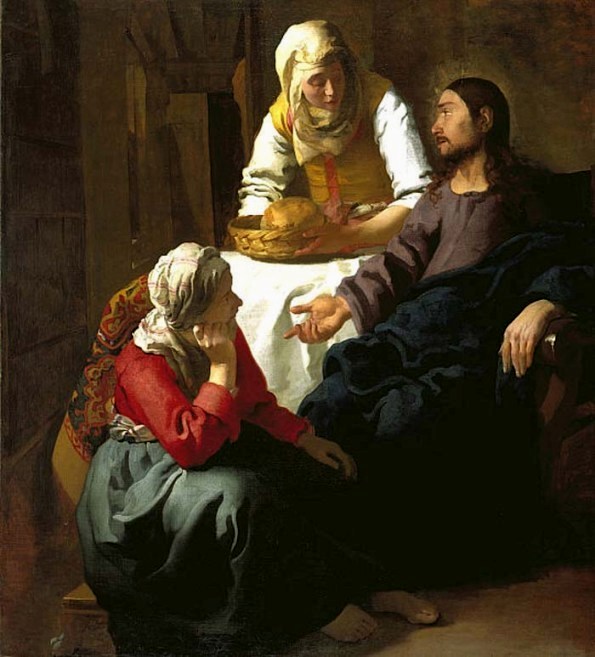
It had been about six months earlier in the home of Mary, Martha, and Lazarus when Martha had complained to Jesus about Mary’s choice to sit at His feet and learn from Him rather than help with the meal service.
But the Lord said to her, “My dear Martha, you are worried and upset over all these details! There is only one thing worth being concerned about. Mary has discovered it, and it will not be taken away from her.” Luke 10:41-42 NLT
“There is only one thing worth being concerned about.” Don’t miss this instruction from our Lord. Mary did not miss it. In his book The Christ of the Gospels (pub. 1946), J. W. Shepard comments:
He exalts fellowship with Him to a very high place of excellence and permanence in the life of the disciples. This is the principle thing needful for life and its reward is permanent and “will not be taken away.” … It was Mary who braved all ridicule, scorn, and criticism later when she broke the expensive alabaster box of wonderful perfume and anointed Jesus “against His burial.” The reason she attained that height of devoted service in a perilous hour was because she before had chosen, “the good part, of sitting at the feet of Jesus.” Her reward has never been taken away.
Ahead of Lazarus whom Jesus had raised from the dead, ahead of Simon whom Jesus had healed of leprosy, ahead of the disciples who had walked with Jesus for three years, before the discourse in the upper room where Jesus issued His straightforward prime directive to abide in Him, Mary had discovered the one single and simple life priority for all believers – to know Jesus.
David had made this same discovery, reducing his life to one single priority:
One thing I have asked from the Lord, that I shall seek:
That I may dwell in the house of the Lord all the days of my life,
To behold the beauty of the Lord
And to meditate in His temple. Psalm 27:4 NASB
Paul had done so as well:
I want to know Christ and experience the mighty power that raised him from the dead. I want to suffer with him, sharing in his death, so that one way or another I will experience the resurrection from the dead! I don’t mean to say that I have already achieved these things or that I have already reached perfection. But I press on to possess that perfection for which Christ Jesus first possessed me. No, dear brothers and sisters, I have not achieved it, but I focus on this one thing: Forgetting the past and looking forward to what lies ahead, I press on to reach the end of the race and receive the heavenly prize for which God, through Christ Jesus, is calling us. Philippians 3:10-14 NLT
Mary’s passionate pursuit to learn more and more about Jesus resulted in an overwhelming love for her Savior that issued forth in an incredible act of worship and witness. This is a brand of love that springs forth from a life of devotion and dedication to Jesus and to His Word. This is the passion and devotion to Christ that men like Ironside, Chafer, Spurgeon, and Tozer exhorted their listeners to seek, exemplifying for us a heritage of godliness that has become but a memory. This is the manner of love to which the glorified Christ was referring when He rebuked the church at Ephesus for leaving their “first love.” (Rev. 2:4)
It is this passionate and overwhelming love for the person of Christ of which most 21st century believers have utterly lost sight. Or perhaps more correctly they have never known of its existence, for unlike the experience of pre-WWII American believers, their encounters with it in our current entertainment dominated culture are rare and often misinterpreted. This is a tragic situation considering the fact that the type of love and devotion demonstrated by Mary is the scripturally expected standard for believers in Jesus Christ, just as Paul clearly inferred when he wrote these words to the believers in Corinth:
For I am jealous for you with the jealousy of God himself. I promised you as a pure bride to one husband – Christ. But I fear that somehow your pure and undivided devotion to Christ will be corrupted, just as Eve was deceived by the cunning ways of the serpent. 2 Corinthians 11:2-3 NLT
Mary’s display was extraordinary within the context of its setting prior to Jesus’ resurrection, ascension, and giving of the Holy Spirit. It should not be considered extraordinary for New Testament believers living on the resurrection side of the cross who are indwelt by the Holy Spirit of God. Yet therein exists our current plight. A corrupted and complacent devotion to our Savior is epidemic within the ranks of true believers in Jesus Christ.
What must we do to reverse our course, to restructure our lives around the simple priority of knowing Christ, to measure up to the examples set by David, Paul, and Mary, to measure up to the stature of Christ Himself? How do we free ourselves from the entertainment-driven cultural addictions to which our own sin has so bound us that we live out our Christian lives in self-satisfaction and ineffective ignorance? How do we begin to seek a vanishing godliness?
 Unassailable Gospel