

At the risk of sounding old-fashioned and perhaps a little out of touch, I am going to address an issue that has been pressing on my mind for quite some time now. I am convinced that we, as a society, have become so addicted to the various forms of visual mass media, endless entertainment opportunities, and infinite amusement options available to us today that, just as a heroin addict can think of nothing but where to obtain his next fix, our cultural psyche is dominated and controlled by thoughts of and desires for more and better pleasure-seeking diversions – all to the exclusion of the noble pursuits that were once a hallmark of the American experience. Television, which had its ostensibly innocent beginnings during the post-war years of the late 1940s and early 1950s, has now become the opiate of the masses. The pursuit of frivolity has become an all-consuming American passion.
The effect of this modern American cultural shift on American Christianity has been devastating. The breathtaking natural landscape of Christian thought that was once dominated by a humble desire to diligently forge an ever-growing and deepening relationship with our Savior has been effectively bulldozed and replaced by the intellectual equivalent of a sewage treatment facility – processing by rationalization all of the popular garbage of the world into products deemed suitable by Christians for their own unrelenting leisure-time consumption. What was pornography twenty years ago, for example, is now regarded as artful television entertainment, and Christians are flocking to it. The end result of this new-wave Christianity is that we now have multiple generations of believers who have no idea of the beauty of the former state. That which they see now is the way they think it has always been. A shallow understanding of scripture, an entertainment-based church experience, a worldly and unseparated lifestyle, a lackluster desire to learn or grow in Christ-like maturity – these are all perceived by legions of modern believers to be the normative characteristics of their faith. Holiness, if even considered, is not important enough to be sought. Godliness has been supplanted by silliness.
In order to provide a snapshot of what the landscape of Christian thought once looked like, especially as regards the subject of our relationship with Christ and the godly lifestyle that should ensue, I would like to consider the witness of some men who lived it and wrote about it. These were great men of God who wielded influence, not only because of their tremendous spiritual understanding, but because they ministered during an age when that spiritual influence mattered to people. Four examples will suffice. It is no coincidence that these notable men all land on the same mark when it comes to the subject of true fellowship with Christ. I do not know of any voices today that speak with the same zeal or knowledge on this topic. They may well exist, albeit in anonymity, as their audience has most certainly deserted them.
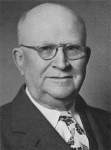
Dr. Henry Allen “Harry” Ironside (1876 – 1951) was a widely respected bible teacher, scholar, theologian, and pastor. He pastored the Moody Bible Church in Chicago from 1929 to 1948, a span that included both the Great Depression and World War II. During that same period of time he was a frequent visiting lecturer at Dallas Theological Seminary, having turned down an offer of a full-time faculty position at DTS in 1926. Although Ironside’s formal education went only as far as the eighth grade, he was a man possessed of an enormous mental capacity. He was the recipient of two honorary doctorate degrees and was one of the most prolific Christian writers of the 20th century. Ironside’s commentaries are considered standards.
In his book “Addresses on the Song of Solomon” published in 1933, Ironside writes these words:
No one has ever entered into the truth of communion with Christ until He Himself has become the all-absorbing passion of the soul. His love transcends every earthly joy…For that reason I am always grieved in spirit when some young Christian comes to me with the old, old question, “Do you think there is any harm in this or that? – any harm in the theater, in dancing, in a game of cards, in the social party that has no place for Christ?” I say to myself, “If they only really knew Him, they would never ask such questions.”…One minute spent in fellowship with Him is worth all the joys of earth.
Dr. Ironside speaks from a level of spiritual understanding to which most believers in our day can not relate. Young believers are still asking the same question that Harry Ironside referred to 85 years ago as the “old, old question.” How are we responding to this query in its modern context? Are we attempting to steer young disciples to a deeper relationship with Christ or are we just trying to modify behavior patterns with a system of inconsequential dos and don’ts? How many of us today consider Christ “the all-absorbing passion of the soul?” How many of us turn the television off long enough to give it a thought?

Dr. Lewis Sperry Chafer (1871 – 1952) was a brilliant theologian and the founder and first president of Dallas Theological Seminary. Known for his balanced and simple lifestyle, Chafer was a heavyweight among 20th century Christian thinkers. His eight volume Systematic Theology, an endeavor that took him ten years to complete, was published in 1947 and sold out the first printing in six months. Since then it has been reprinted numerous times and is a staple of seminary libraries.
In his book “Major Bible Themes” (pub.1926), Dr. Chafer makes this statement based on Ephesians 6:11-12 regarding the strategy Satan employs in his warfare against God’s children:
The attack against the children of God is not in the sphere of “flesh and blood,” but in the sphere of their heavenly association with Christ. That is, the believer may not be drawn away into immorality, but he may utterly fail in prayer, in testimony, and in spiritual victory. Such failure, it should be seen, is as much defeat and dishonor in the sight of God as those sins which are freely condemned by the world.
The fact that Chafer believed the focus of Satan’s attack is in the sphere of our association with Christ reveals his attitude as to the vital importance of that abiding fellowship. It is essential – a fact the devil clearly understands even if we do not.
“Such failure, it should be seen, is as much defeat and dishonor in the sight of God as those sins which are freely condemned by the world.” This is strong language. What sins does the world freely condemn? Murder? Rape? Can my lack of dedication to Christ be compared to such awful acts? A building subjected to willful neglect over time will be rendered just as useless to its purpose as that building which is suddenly destroyed by the wrecking ball. The difference is one of the properties can be rebuilt. The other will remain a blight for as long as it stands.

Charles Spurgeon (1834 – 1892) was and still is one of the most influential Christian thinkers and orators of all time. Of all who have ever taught on and written about the Word of God, he was perhaps the most prolific. He must certainly be the most quoted. Spurgeon served as pastor of the Metropolitan Tabernacle in London for 38 years. Included in his long list of written works are thousands of sermons delivered during his ministry with that congregation.
Here is a quote from Spurgeon’s sermon, “The Two Yokes.” Spurgeon delivered it on January 14, 1872. In it, he used a brilliant illustration comparing two different perspectives on a life of dedication and holiness:
O beloved, the life of the true Christian is not a life chafed and galled with vexatious prohibitions, because pursuits which, to the non-Christian heart are distasteful and repulsive, to the renewed heart are a matter of intense delight. A man shall carry a bucket of water on his head and be very tired with the burden, but that same man when he dives into the sea shall have a thousand buckets on his head without perceiving their weight, because he is in the element and it entirely surrounds him. The duties of holiness are very irksome to men who are not in the element of holiness; but when once those men are cast into the element of grace, then they bear ten times more and feel no weight, but are refreshed thereby with joy unspeakable. Christ’s yoke is easy, for the new heart rejoices in it.
“In the element of holiness…” Spurgeon knew what it was like to live his life in daily fellowship with Christ. I am afraid that most believers today view that manner of life from the perspective of the man with the bucket of water on his head. The gods of this world, the media moguls and entertainment elite, have taught them that fellowship with Christ and devotion to God is an undue burden. Most do not even know there exists an ocean of grace into which they can immerse themselves, to live in the “element of holiness” where “Christ’s yoke is easy, for the new heart rejoices in it.” They do not know because it is no longer commonly taught, just as Paul predicted in 2 Timothy 4:3-4.
For a time is coming when people will no longer listen to sound and wholesome teaching. They will follow their own desires and will look for teachers who will tell them whatever their itching ears want to hear. They will reject the truth and chase after myths.
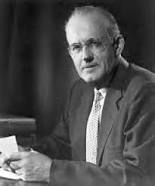
A.W. Tozer (1897 – 1963) was a teacher and author, and the pastor of Southside Alliance Church in Chicago from 1928 to 1959. Born into poverty and almost completely self-educated, his written body of work is impressive. While there are over sixty books that bear his name (some of them are posthumous compilations of his sermons and articles) there are two considered to be modern Christian classics: The Pursuit of God and The Knowledge of the Holy. The overriding theme of all of his written legacy is the necessity for a deeper relationship with God.
From his book The Pursuit of God (pub. 1948), Tozer relates this observation regarding believers of old and their diligent pursuit of God:
Come near to the holy men and women of the past and you will soon feel the heat of their desire after God. They mourned for Him, they prayed and wrestled and sought for Him day and night, in season and out, and when they had found Him the finding was all the sweeter for the long seeking.
Two pages later he makes this incredible statement:
I want deliberately to encourage this mighty longing after God. The lack of it has brought us to our present low estate. The stiff and wooden quality about our religious lives is a result of our lack of holy desire. Complacency is a deadly foe of all spiritual growth. Acute desire must be present or there will be no manifestation of Christ to His people. He waits to be wanted. Too bad that with many of us He waits so long, so very long, in vain.
This was written 70 years ago! The cultural condition of Christianity that Tozer believed to be true then (our present low estate) has been magnified and expanded exponentially today by the dominating influence of the potentates of the mass media / entertainment empire.
“Complacency is a deadly foe of all spiritual growth.” Webster’s definition of complacency: satisfaction with one’s own merits, especially when accompanied by ignorance of actual dangers or deficiencies. Has there ever been a time in history when those who call themselves God’s people, those who should be intimately familiar with God’s revelation, have been more complacent than our American church is today? I believe one would have to go all the way back to the Jewish population of Jesus’ day in order to find a comparable culture of complacency.
The problem here is not that there is a shortage of godly, intelligent Christian men and women ministering in America today. I personally know a few. The problem is that most Christians today are too distracted to listen to them. After all, we have fantasy football leagues to attend to and a new Netflix series waiting to be binge-watched. Therein lies the truly alarming aspect of our current cultural climate and the immersive influence of the 700 billion dollar U.S. media and entertainment industry. It is the ease in which the charms and lies of endless amusements hijack the hearts and minds of Christians and distract them from the one critically important thing in their lives – an abiding relationship with our Lord and Savior Jesus Christ. We subsist in a Dispensation of Silliness.
How did we arrive at such a low level of spiritual subsistence? What drew us away from the strong meat of God’s word to the steady diet of spiritual junk food that so many believers today seem to crave? In attempting to answer these questions I believe it would be worthwhile to take a peek through a “window” into the American mind of the early 1960s. I am of the opinion that this is where we will find the genesis of our current crisis.
Political speeches make great windows into which we can look to gain insight into the societies to which they were addressed. Successful politicians must be good communicators and as such, they must speak in a manner in which they know they will be understood by the common citizen. By extension, the manner in which they communicate says much about the nature and concerns of their audience. Just a cursory reading of Lincoln’s first inaugural address, for instance, leaves little room for speculation as to the primary social issues that led to the Civil War. (It was all about slavery, by the way.)
Political speeches also say much about the intellectual abilities of the general population to which they are addressed. I’ve chosen an example from the early sixties. Consider the language, thoughts, and ideas expressed by this popular and successful politician from the past and ask yourself: Could our president today deliver a speech of similar eloquence and intelligence and expect to be understood, or even listened to, by the majority of America’s voting population?
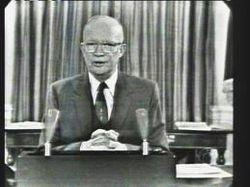
On January 17, 1961, outgoing U.S. President Dwight Eisenhower delivered the farewell address in which he famously warned our nation to guard against the potential threat of the profit-driven “military-industrial complex.” In a process no doubt indicative of the character of the man who orchestrated the planning and preparation of the D-Day invasion, Eisenhower invested nearly two years and went through over 21 drafts in the preparation of his final speech as President of the United States. It was not just a tweet. He apparently put some thought into it. The portion of the speech that has been so widely written about, referenced, and commented upon reads as follows:
In the councils of government, we must guard against the acquisition of unwarranted influence, whether sought or unsought, by the military-industrial complex. The potential for the disastrous rise of misplaced power exists and will persist. We must never let the weight of this combination endanger our liberties or democratic processes. We should take nothing for granted.
It is an eerily prophetic statement considering the nearly nonstop string of profitable military conflicts that the U.S. has been a part of since WWII. However, the genius of Ike’s observations, in my opinion, lies not in these four oft-quoted sentences. It has never been a secret that greedy and lustful men will seek money and power however they can attain them. Eisenhower’s farewell address was fundamentally not a warning about the influence of corrupting greed and power in government.
Eisenhower, referring to himself as a “fellow citizen,” was intent upon bringing a solemn warning to the citizens of the United States that a price had to be paid to measure up to the duties and responsibilities incumbent upon them as citizens of a free nation and as demonstrated by past generations of Americans. Paragraph six of the speech reads as follows:
Throughout America’s adventure in free government, our basic purposes have been to keep the peace; to foster progress in human achievement, and to enhance liberty, dignity and integrity among people and among nations. To strive for less would be unworthy of a free and religious people. Any failure traceable to arrogance, or our lack of comprehension or readiness to sacrifice would inflict upon us grievous hurt both at home and abroad.
It is clear from the preceding quote that, in Eisenhower’s mind, the cost of measuring up as a free U.S. citizen had to be paid in the learning of humility, the pursuit of wisdom (comprehension), and a willingness to sacrifice. It is also clear that Eisenhower expected his listeners to both understand the challenge as presented to them and to step up to meet it. If Ike were alive today I fear he would be disappointed in us. Whether by neglect or intent, it is certain that not one of these three things could at present be considered signature characteristics of our American society. Sorry, Mr. President, at some point during the last 50 years your wise admonitions were shoved into the great chasm of irrelevance.
The true genius of Ike’s speech is summed up in the oft-neglected sentence that immediately follows the “military-industrial complex” passage:
Only an alert and knowledgeable citizenry can compel the proper meshing of the huge industrial and military machinery of defense with our peaceful methods and goals, so that security and liberty may prosper together.
“Only an alert and knowledgeable citizenry…” This was the crux of the matter in Eisenhower’s view. The retention of an alert and knowledgeable U.S. citizenry was, in the President’s opinion, imperative to the survival of a free and prosperous nation. There is an implied assumption here on Ike’s part that he was indeed addressing citizens who complied with that description, though he certainly appears apprehensive for its future continuance.
Unfortunately, I do not believe that any reasonably rational person today could describe our current American citizenry as “alert and knowledgeable,” that is if you can find a reasonably rational person, i.e. someone who has read a few nonfiction books and has not built their entire worldview on Facebook memes and 140 character tweets.
Clearly, the fundamental character of our corporate American mind has, over the course of the last five decades, been unfavorably altered. We have become a society that now lives to be entertained and amused. We spend billions of dollars per year attempting to accomplish that goal. “Alert and knowledgeable?” The emergent dominance of the mass-media/entertainment complex that has developed over the last 50 years, doubtless unforeseen by Eisenhower, has led to a successful numbing of our culture and brought us to the point that we would be more aptly described as glassy-eyed and stupid.
President Eisenhower delivered his farewell speech at the dawn of the television age. The vocabulary, the phrasing, the complexity of his sentences, and the expectations – both stated and implied – are all indicative of a bygone era in which normal, everyday people were able to process and engage in abstract thought without the need for visual assistance. A political speech of this nature would be incomprehensible to everyday Americans in 2017. Political dialogue naturally degrades to the level of its hearers.

Ike could not have foreseen the wayward direction television and other forms of visual media and entertainment would be destined take us. However, the general tone of this farewell address does give me the impression that the outgoing president may have had a tingling sense of fear that our citizenry would not stay the course of a free nation – not because we would be unable to pay the cost, but simply because we would not consider freedom important enough to be worth the effort. Well, at least not as important as the release date for the next Star Wars movie.
This current state of our culture is disturbing to say the least, but it should not be a surprise to students of scripture. Paul accurately foretells the future of western civilization and specifically the Christian church in his second letter to Timothy. Look again at 2 Timothy 4:3-4.
For a time is coming when people will no longer listen to sound and wholesome teaching. They will follow their own desires and will look for teachers who will tell them whatever their itching ears want to hear. They will reject the truth and chase after myths. (2 Timothy 4:3-4 NLT)
Although believers should be model citizens of our nation, fulfilling all the duties and responsibilities described by Eisenhower in his farewell address, we have an immeasurably higher calling as citizens of the kingdom of God:
For I have told you often before, and I say it again with tears in my eyes, that there are many whose conduct shows they are really enemies of the cross of Christ. They are headed for destruction. Their god is their appetite, they brag about shameful things, and they think only about this life here on earth. But we are citizens of heaven, where the Lord Jesus Christ lives. And we are eagerly waiting for him to return as our Savior. (Philippians 3:18-20 NLT)
Just as Eisenhower laid out the standard of measure for citizens of our nation, the apostle Paul, in like manner, laid out the standard of measure for citizens of heaven:
… until we all come to such unity in our faith and knowledge of God’s Son that we will be mature in the Lord, measuring up to the full and complete standard of Christ. Then we will no longer be immature like children. We won’t be tossed and blown about by every wind of new teaching. We will not be influenced when people try to trick us with lies so clever they sound like the truth. (Ephesians 4:13-14 NLT)

The Greek phrase translated here as “measuring up” is eis metron helikias – literally “unto the measure of the stature.” The phrase in this context presents a word picture of a child eagerly measuring and marking his growth progress against a set standard, perhaps an older brother or parent. As believers it is our duty and responsibility to grow and to eagerly track and measure our own progress as we mature in a manner of life that imitates Christ and honors God.
In addition, notice the end result of growing to maturity in Christ -“We will not be influenced when people try to trick us with lies so clever they sound like the truth.” (Ephesians 4:14b NLT)
I know I am repeating myself but I will say again: the truly alarming aspect of our current cultural climate and the immersive influence of the American media and entertainment industry is the ease in which the charms and lies of endless amusements hijack the hearts and minds of Christians and distract them from the one critically important thing in their lives – an abiding relationship with our Lord and Savior Jesus Christ. He Himself said:
Abide in Me, and I in you. As the branch cannot bear fruit of itself unless it abides in the vine, so neither can you unless you abide in Me. I am the vine, you are the branches; he who abides in Me and I in him, he bears much fruit, for apart from Me you can do nothing. John 15:4-5 NASB
The Greek verb in verse four (abide) is in the imperative mood. That means it is a command. It is a direct command from Jesus with a promise: “he who abides in Me…he bears much fruit.” It is also a command with a warning: “for apart from Me you can do nothing.” Clearly, apart from an abiding relationship with Christ, we can not grow in maturity, “measuring up to the full and complete standard of Christ.”
The implication here is that true believers can and sometimes do have shallow relationships with Christ resulting in stagnant growth, a joyless life, and an abated testimony for God. The tragedy of our current day and age is that this level of stunted maturity has become the normative characteristic of modern American Christianity.
Any believer who chooses to break with the new-wave Christian culture of today, and to diligently maintain a lifestyle eagerly pursuing the measure of the standard of Christ, must be forewarned that his path will take him through an environment steeped in hostility, not only from unbelievers (as would be expected), but from worldly and immature true believers who have become captives of the cultural influences that dominate our society.
We can be comforted that our Lord, in His incarnation, was well-acquainted with these very same trials. Moreover, in one incredible instance recorded by three of the four gospel writers, He memorialized forever a woman who braved hostility from all those around her as she gave a unique testimony to her devotion to and knowledge of the One who was soon to give His life for her salvation.
 Unassailable Gospel