
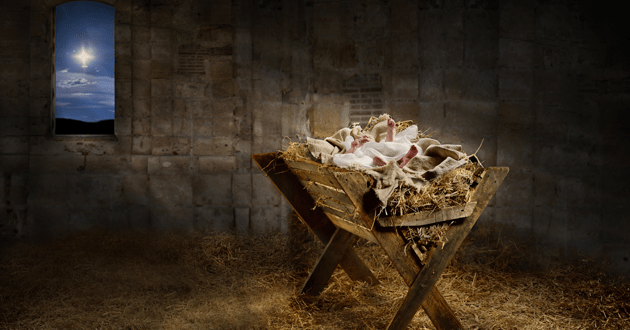
God could not draw nearer, nor could He disclose more clearly the wonders of His Person, the perfections of His purpose, or the depths of His love and grace, than He did in the Incarnation… Lewis Sperry Chafer
The first book of the Old Testament was written by Moses. In fact, he wrote the first five books of the Old Testament. The prophet Malachi wrote the final book of the Old Testament. The time span between these two prophets is about 1000 years. It was a 1000-year period of a ‘many parts and many manners’ revelation. Between Malachi and the birth of Christ stands another 400 years – a 400-year span of what seems, on the surface, to be silence from God. Yet it was not truly a period of silence at all, for God was working, manifesting His sovereign rule in the ordering and unfolding of 400 years of human history in preparation for the advent of His Son. It was, in effect, a 400-year drumroll leading to the most inscrutable of all the mysteries of the divine Trinity – the Incarnation. God would become man, and having spoken in many parts and many manners through the Old Testament prophets, He would now spend 400 years preparing the world for His next and final message. He was preparing to speak once and for all in a new manner and in a new language. He was preparing to speak in Son.
During that 400-year span of time from Malachi to the manger, the beat of the drums of history rolled as the mighty Persian Empire collapsed beneath the thundering hooves of the cavalry of Alexander the Great; and God used the military genius of that singular young Macedonian ruler to spread the dynamic language of the Greeks throughout the known world. It would become the language of the New Testament, a language unequaled in its ability to express the majesty and wonder of the unveiled glory of God which would be revealed in His Son.
The drumroll grew in intensity as the tiny city of Rome advanced to become the greatest military power in history, overwhelming Alexander’s Greek world with the brutal efficiency of the gladius and by the merciless imposition of law, order, and taxes. Rome anchored its immense strength and influence not upon the destruction and plunder of its enemies and the subsequent annihilation of conquered cultures, as had all previous world powers, but in the preservation and prosperous development of its conquered subjects. Prosperity under the iron-fisted and merciless rule of Roman law translated into taxable wealth, by which Rome could afford not only to keep standing armies but to build infrastructure, including thousands of miles of roads that kept the empire connected and allowed for the rapid deployment of military might where needed.
It would be that same remarkable road system, engineered and built with Roman taxes, upon which the gospel would travel and spread throughout the civilized world. Indeed, it would be Roman taxation that, in fulfillment of Old Testament prophesy, would bring Mary and Joseph to Bethlehem; and it would be Roman taxes that would ultimately finance the execution of the One who was to be born there in a stable. The physical costs – lumber, hardware, labor, management – associated with the realization of the great doctrine of justification by faith were to be paid with Roman taxes.
The ‘long ago’ revelation of God’s glory, as described in Hebrews 1:1, came to us through the prophets as God’s chosen intermediaries. It was the revelation of a veiled glory, a partially covered majesty, and an incomplete message. Much of God’s character was made manifest, but not all. God’s words were heard but they were not delivered by His voice. There was something missing. God was present and yet distant. The Old Testament saints and prophets knew this. They longed for a deeper knowledge of God. The psalmist speaks for all of them when he says: “As the deer longs for streams of water, so I long for you, O God” Psalm 42:1. God is faithful and true, and He did not leave the saints of old bereft of hope for the fulfillment of their deep longing for His presence.
A cursory glance at the prophesy of Isaiah might initially lead one to believe that God had indeed forsaken the saints of Old Testament times. The first 39 chapters of the prophetic book are devoted primarily to the pronouncement of judgement on Israel and on the gentile nations. For the most part it is 39 chapters of doom and gloom. But then comes chapter 40. Suddenly the whole tenor of the book takes a 180-degree turn. Chapter 40 begins with the words “Comfort, yes, comfort my people!” What follows in the next three verses is a passage that Jesus directly associates with the ministry of John the Baptist. Verses 3 and 4 are probably familiar to you:
The voice of him that crieth in the wilderness, Prepare ye the way of the LORD, make straight in the desert a highway for our God. Every valley shall be exalted, and every mountain and hill shall be made low: and the crooked shall be made straight, and the rough places plain:
And then we get to Isaiah 40:5. I love this verse:
Then the glory of the LORD will be revealed, and all people will see it together. The LORD has spoken!
THE GLORY OF THE LORD WILL BE REVEALED! Verse 2 of Hebrews chapter 1 describes the fulfillment of this prophesy. Just as Genesis 1:1 initiates the revelation of the glory of God, Hebrews 1:2 proclaims its magnificent culmination:
(God)…has in these last days spoken to us by His Son, whom He has appointed heir of all things, through whom also He made the worlds Hebrews 1:2 NKJV
This is an incredible statement. Let’s jump directly to the main thought first – God has spoken to us ‘by His Son.’ Note that in our English translation the word ‘His’ is italicized. That means it is not in the original Greek manuscripts but was supplied by the translators in an effort to make the English text more readable. The Greek phrase translated ‘by His Son’ is actually just two words: en huio. The literal translation is ‘in Son.’
God spoke to us IN SON! In other words, God spoke to us IN JESUS. Jesus is not the means of communication, He is the communication. That is the thought encapsulated in those two words – en huio, in Son. Everything that God has to say to mankind has been spoken to mankind in the person of Jesus Christ. Whereas in the past God had spoken via the prophets as intermediaries – in the out-speakers – now He has spoken to us directly ‘in Son.’
Jesus Himself is the direct voice of God and, not only is He the voice of God, He is the language of God. Just as a Spaniard speaks in Spanish and a German speaks in German, God speaks ‘in Son.’ The Son of God is the complete revelation of God’s glory. If we want to understand God, if we want to see the unveiled glory of God, we must study and speak the language of God. We must learn Jesus. In Him Isaiah’s prophesy has been fulfilled – the glory of the Lord has been revealed! – unveiled in all of its fulness and majesty.
Here in the first sentence of this magnificent epistle, the writer of Hebrews sets forth Jesus as the supreme revelation of God and as the perfect and complete fulfillment of the Old Testament scriptures that were delivered in ‘many parts.’ Jesus is the missing piece for which the probing Old Testament prophets carefully searched. He is the lens through which the Old Testament must be viewed in order for it to be understood. He is the fulfillment of all of the pictures and types of the Old Testament; and He is the living Word of truth whose death and resurrection validates all of the prophesies of the Old Testament.
The shed blood of Christ is a scarlet thread that runs through every page of the Old Testament. All of the variegated ‘many parts and many manners’ revelations of the Old Testament scriptures now make sense and coalesce into one divine truth, and it is a Person – a Person who is God of very God and man of very man. “For in him dwelleth all the fulness of the Godhead bodily” Colossians 2:9. He is, as well, a Son – a Son to whom the Father has given over all judgement (John 5:22).
The author of Hebrews uses a verb tense and mood (aorist / indicative) that views the action – ‘He spoke to us in Son’ – as a one-time completed past event. He then places this event on a historical timeline with the phrase ‘in these last days,’ or more accurately, ‘at the last of these days.’ The ‘days’ he is referring to are the ‘long ago’ days of verse 1. God spoke to us ‘in Son’ at a specific point in time at the very end of the Old Testament period – ‘at the last of these days.’ There is no doubt that it is the Nativity to which this verse is pointing. The author of Hebrews positions the birth of Christ as the pinnacle event of world history and the culmination of YHWH’s progressive self-revelation.
While we tend to view the birth of Christ as a New Testament event because it is described for us in the New Testament gospels, the author of Hebrews places the event at the very close of the Old Testament period. As such, it is the resolving chord of God’s great revelatory symphony that opened with the powerful declaration “In the beginning God….” and now closes on the magnificent note described in John 1:14:
And the Word was made flesh, and dwelt among us, (and we beheld his glory, the glory as of the only begotten of the Father,) full of grace and truth.
There is an aspect to the writer’s verb choice in this passage that we would do well to look at more closely. He is using the Greek aorist tense in what is called the ‘culminative’ sense. This means that the ‘speaking’ event described in verse 2 is to be viewed as completed in its entirety, but to be regarded “from the viewpoint of its existing results” (Dana and Mantey, Manual Grammar of the Greek New Testament).
In other words, the Incarnation of Christ is considered here in the unity of its full scope and purpose – not just His birth, but also His life, example, teaching, death, resurrection, ascension, return, and eternal rule. All of these things and more are included in the writer’s panoramic view of God becoming man. We do not have here a simple reference to the birth of a baby with further revelation to come as the child grows and fulfills God’s purpose. The thought here is that the entire revelation of God’s glory is complete in the presence of Jesus Christ, God incarnate. This point will be made more clear when we look at verse 3. For now it is sufficient to say when God became man, when He spoke in Son, He left nothing unsaid.
The literal aorist translation of the verb is ‘spoke,’ but if it is used in the culminative sense it is typically translated into English in the perfect tense – ‘has spoken.’ All reliable English translations that I have looked at are in agreement with the culminative aorist use and translate the verb as ‘has spoken.’
So what does it all mean? Simply this: There is nothing yet to be revealed about God that has not already been revealed in Jesus, His Son. We do not wait for further revelation, it will not come. Rather, we need to be peering more deeply into what has already been revealed. God’s revelation is complete. If you are a believer, your apprehension of God’s glory – now revealed to us in the person of His Son – will keep you occupied throughout eternity. That thought alone should cause us to long for a greater knowledge of Him in this life. He has spoken to us in Son. Are you listening?
The history of the revelation of God’s glory from beginning to end, from Alpha to Omega, is presented to us in exquisite and stunning precision in these first two verses of the Book of Hebrews. God has shown us His glory! How can we not seek to know Him better?
 Unassailable Gospel
Leave a comment