

…one of the most urgent tasks facing evangelical Christendom today is the recovery of the gospel…for its first concern was always to give glory to God. It was always and essentially a proclamation of divine sovereignty in mercy and judgement, a summons to bow down and worship the mighty Lord on whom man depends for all good, both in nature and in grace. Its centre of reference was unambiguously God. But in the new gospel the centre of reference is man…Whereas the chief aim of the old was to teach people to worship God, the concern of the new seems limited to making them feel better. J.I. Packer – A Quest for Godliness
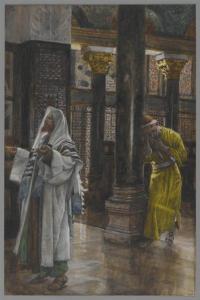
In the introduction to his narrative Luke tells us that Jesus directed this parable to “some people who trusted in themselves that they were righteous, and viewed others with contempt.” This characterization of the target audience is descriptive of the entire culture of 1st century Judaism. It is, in fact, as concise a description of Pharisaic Judaism as exists in the scriptures. The Pharisees were a small but extremely powerful religious sect that judiciously maintained a dominating influence over the everyday lives of 1st century Jews. The 1st century Romano-Jewish historian Flavius Josephus (who was probably a Pharisee himself) estimated the total number of Pharisees with whom he was contemporary at 6000. Estimates of the world Jewish population in the 1st century range anywhere from 4 to 8 million. Thus the Pharisees, in number, accounted for only about 0.1% percent of the entire Jewish population of the world at that time. In his book “New Testament History” (pub. 1969), highly regarded biblical scholar F.F. Bruce gives us some insight into the influence wielded by this small but powerful group of men:9 And He also told this parable to some people who trusted in themselves that they were righteous, and viewed others with contempt: 10 “Two men went up into the temple to pray, one a Pharisee and the other a tax collector. 11 The Pharisee stood and was praying this to himself: ‘God, I thank You that I am not like other people: swindlers, unjust, adulterers, or even like this tax collector. 12 I fast twice a week; I pay tithes of all that I get.’ 13 But the tax collector, standing some distance away, was even unwilling to lift up his eyes to heaven, but was beating his breast, saying, ‘God, be merciful to me, the sinner!’ 14 I tell you, this man went to his house justified rather than the other; for everyone who exalts himself will be humbled, but he who humbles himself will be exalted.” Luke 18:9-14 NASB
… the high priests were regularly selected from the wealthy Sadducean families, and these families dominated the Sanhedrin (ruling council). But although the Pharisees were in the minority, their popular support was such that in the Sandedrin as well as out of it they enjoyed an influence out of proportion to their numbers. According to Josephus … Sadducean magistrates acquiesced in Pharisaic principles because they saw that this was the only way that they could persuade the people to tolerate them.The Pharisees had built up an oral tradition of interpretation and application of the Mosaic law that, to the Jews, had become just as sacred as the scriptures themselves. In doing so they had taken the law, which was intended to be the guide to bring people to Christ (Galatians 3:24), and turned it into a burdensome collection of trivial regulations by which one could work to make himself right before God. Jesus referred to these teachings as the leaven or yeast of the Pharisees (Matthew 16:5-12) and as surely as a little yeast transforms an entire batch of dough, the leaven of the Pharisees transformed the mindset and culture of God’s chosen people. The Pharisaic metamorphosis of Judaism effectively obscured the genuine truth of the word of God and replaced it with a counterfeit works-based belief system. From a sermon delivered in 2006, John MacArthur had this to say in regard to Pharisaic influence:
The Pharisees were the great architects of a system of self-righteousness that dominated life in Israel. They had the greatest influence on the populace because they had power in the local synagogues everywhere which were basically ruled by their theology.The Jews had been entrusted with the whole revelation of God with the divine intent that they be the channel of God’s truth to the entire world, a city set on a hill whose light could not be hidden. And yet, when the Son of God visited them, they did not know Him. 1st century Jewish history testifies to the tragic consequence of a believing people beguiled by the popular culture in which they have become immersed. In that regard the similarity between 1st century Israel and 21st century America is striking. Solomon spoke truly when he said, “There is no new thing under the sun.” (Ecclesiastes 1:9) Note how Luke’s introduction links self-righteous pride with contempt for others. The two are inseparable. The presence of open contempt always betrays the presence of hidden pride. The Pharisees themselves were so scornful of the common Jewish population that they had a name for them, ‘am ha’ares, which literally meant ‘the people of the land’ but for the Pharisees it had a specialized derogatory meaning of ‘religious ignoramus.’ We live in a society today that is permeated by contemptuous attitudes towards others, so much so that we have completely lost the moral discernment that would ordinarily deem ‘contempt’ to be a cruel and profane character flaw. Rather, our culture seems to find it not only entertaining, but has positioned contemptuous behavior as fashionably in vogue. I was astonished this past holiday season when a major sporting goods chain aired a commercial in which a ‘hero’ mother, participating in a victorious mock press conference after a “winning” shopping experience, refers scornfully to an employee of a competitor’s store as “some tweenager.” Since when is it acceptable to laud the behavior of a woman who publicly belittles another mother’s child? Especially when the only purpose of the sneering remark was to enhance the speaker’s credibility as a wise consumer? Apparently it is just fine in 21st century America as evidenced by the fact that this commercial ran repeatedly over an extended period of time. It is undeniable that Jesus’ target audience extends well beyond the confines of 1st century Palestine. Our Lord chose the character of a Pharisee to represent all of contemporaneous Jewish society and, by extension, His entire target audience: that is, all those that are confident of their standing with God based upon their own, not God’s, measure of righteousness. The Pharisee refers to himself in the first person five times in just two verses. He nearly demands just treatment from God based upon his own achievements. He holds others in contempt. He is the epitome of pride. He thinks he is the repository of all truth but he is, in fact, hopelessly self-deceived. Consider the two specific activities in which the Pharisee takes such great pride. First, he says he fasts twice a week. The Old Testament only prescribed one fast, that occurring on the Day of Atonement. The Pharisees had made it a tradition to fast on Mondays and Thursdays every week – probably because those were market days and they would be seen by more people. Second, he brags that he gives a tenth of all that he gets. The Pharisees were known for tithing from the food they ate, from tiny seeds and spices, basically from everything they could think of. Again, this was their own tradition, not the law of God. The Old Testament prescribed three tithes to support the theocracy of Israel – 10% to the national government, 10% to support the national religious festivals, and 10% every 3 years to take care of the poor. These three tithes together added up to a 23.33% tax rate on the increase of the land. That was it. No other tithes were called for. The point here is that this Pharisee was occupied with trivialities – activities of no import and no value to God or man. Fasting and tithing beyond the requirements of the law were the outward works upon which he based his claim of righteousness before God, and they meant nothing. They were pointless, foolish occupations that bore no relevance to the fundamental commandments upon which the entire Old Testament law was based:
“‘You must love the LORD your God with all your heart, all your soul, and all your mind.’ This is the first and greatest commandment. A second is equally important: ‘Love your neighbor as yourself.’ The entire law and all the demands of the prophets are based on these two commandments.” Matthew 22:34-40 NLTJesus presents the antithesis of the Pharisee in the person of a corrupt tax collector. Tax collectors were the outcasts of Jewish society, and perhaps rightly so. They were Jews who had renounced their national loyalty in exchange for personal wealth by purchasing from Rome the right to collect Roman taxes from their countrymen. Any money collected over and above what was due to Rome was pure profit for the tax collectors, and profits were extraordinarily high as the tax collectors commonly used hired thugs to extort additional taxes from the citizens of the district or town over which they were given jurisdiction. The tax collectors were the most hated and despised members of Jewish society. Nearly all other Jews considered them to be traitors. Note that neither character in this Everyman tale is a ‘good’ person. The tax collector in Jesus’ parable stands at a distance and will not even look up to heaven, but rather beats his breast with his fist saying, “O God, be merciful to me, for I am a sinner.” That’s all we have – one sentence. In Luke’s Greek text it is just six words, and two of those are articles. Yet, the difference between the way to eternal life and the road to eternal damnation is clearly conveyed to Jesus’ Jewish audience in these six words – for Jesus goes on to say that the hated and despised tax collector would stand justified before God while the highly regarded representative of Judaism, the Pharisee, would not. Our Lord’s Jewish audience must have been stunned: “How could this be?” Jesus’ closing statement, “those who humble themselves will be exalted and those who exalt themselves will be humbled,” is a proverb the theme of which is oft-repeated in the scriptures: God honors humility. David speaks to the same theme, for instance, in Psalm 51:17: The sacrifices of God are a broken spirit: a broken and a contrite heart, O God, thou wilt not despise. Clearly, one must come to God with a humble heart. Humility however, as wonderful a virtue as it is, cannot in and of itself be the basis upon which to declare a sinner not guilty. The tax collector had been a grievous sinner. He was an idolater whose god was money and who took advantage of others for his own personal gain. Humble or not, our contrite tax collector was just as guilty of sin as the self-righteous Pharisee. For all have sinned, and come short of the glory of God. Romans 3:23. Being sorry for one’s actions does not change the fact that the wages of sin is death. Romans 6:23a. God has revealed to us His perfect standard for mankind in Leviticus 11:44: Be holy, for I am holy. No one is able to meet that standard. So then, how can God declare a sinner just without impugning His own righteousness? Job understood this paradox when he asked the question – How can a man be in the right before God? (Job 9:2) The answer to Job’s question remained a mystery for nearly 2000 years throughout the Old Testament and inter-testament ages. Yet, Jesus tells us that the tax collector went to his house justified, or right before God. Could it be that the long-hidden answer to Job’s ancient query was first revealed to the Jews here in this simple illustration recorded only by, of all people, Luke – the only non-Jew of the four gospel writers? If so, what is it that distinguishes these two men, both obviously sinners, as regards their standing before God? Jesus clearly makes a distinction. The answer to this question is critical. It is the difference between eternal life and eternal judgement. All of mankind is represented by one or the other of these two characters. There is no third option. Evidently, the solution to our problem lies in the six words spoken by the tax collector, but we will have to look at the original language and the historical Jewish context in order to see it. This will require that we look at some specific Greek and Hebrew words, but hang with me. I think it will be worth the effort. This passage is just one example of the many untranslatable jewels of the divinely inspired Greek New Testament. The words of the tax collector are rendered as follows in some of the more popular translations:
‘God, have mercy on me, a sinner.’ – New International Version ‘O God, be merciful to me, for I am a sinner.’ – New Living Translation ‘God, be merciful to me, a sinner!’ – English Standard Version ‘God, be merciful to me, the sinner!’ – New American Standard Version God be merciful to me a sinner. – King James VersionAll five of these versions are nearly identical to each other, as they should be. But, the problem with these English translations is that the 1st century Jewish understanding of the Greek word translated “mercy” or “merciful” is not translatable into a single English word. There are two Greek verbs that are typically used in the New Testament to convey a display of mercy: eleeo – to feel sympathy with the misery of another, or oikteiro – to have pity on. Neither of these words is used here. The word translated “mercy” or “merciful” in this passage is the Greek word hilastheti from the hilaskomai word group. It is an old verb that frequently carried the meaning “to be merciful” in ancient Greek texts. Typically that mercy was attained by placating a deity. The phrase “be merciful” is an accurate English translation. However, for a Jewish audience the Greek hilaskomai word group carried a much deeper meaning. It was used to translate the Hebrew kaphar word group, meaning to cover or to make atonement. The kaphar word group is loaded with theological meaning for the Jews. Most significantly, it is the word group from which is derived the Hebrew word for the lid of the sacred ark of the covenant, the mercy seat upon which the blood of the atoning sacrifice was sprinkled once a year. That word is the Hebrew kapporeth – mercy seat. The Greek noun for kapporeth or mercy seat is derived from hilaskomai. It is the word hilasterion. In effect, the divinely inspired terminology that Luke uses to relate this parable to the Greek readers of his gospel depicts a tax collector that is asking God to provide for him a once and for all substitutionary atonement – a one-time mercy seat sprinkling, the value of which would purge his sin forever! Greek scholar Kenneth Wuest, in his expanded New Testament translation, renders the tax collector’s six word prayer as follows:
Oh God, justify me the sinner upon the basis of an expiatory sacrifice which satisfies the demands of divine justice and makes possible the just bestowal of righteousness on the basis of justice satisfied.That is a mouthful for sure, but there is no doubt that every Jew who heard this parable would understand the publican’s request because of its very specific Old Testament sacrificial terminology. I believe an accurate Jewish understanding of the tax collector’s prayer could read something like this: “I am a hopeless, helpless sinner oh God. I know I justly deserve to die. My only hope for salvation from eternal death is that You might send a perfect man to die in my place!” Now, armed with a correct understanding of the tax collector’s request, it becomes apparent what it is that distinguishes the two characters in Jesus’ story as regards their standing before God. The Pharisee is intent on justifying himself based on his own achievements, his superior works. He is convinced that he is righteous enough to stand before God on his own merits. He believes that, unlike the wicked tax collector, he is too good for God to pronounce upon him the death penalty for his sins. The tax collector, on the other hand, knows that he has no merit or standing before God. He knows he is a sinner and he realizes that his only hope to avoid eternal punishment is for God to provide for him a sinless substitute as a basis upon which to declare him justified. The tax collector effectively outlines the grand doctrine of justification, and puts his trust in God to see it through. Therefore Jesus says “This man went to his house justified rather than the other.” This is incredible! A common, lawless Jewish traitor comes up with the answer to a 2000 year old mystery that had been hidden from the view of every Old Testament prophet from Abraham all the way to Malachi. This tax collector must have been a theological genius! And here is the part of this story that is absolutely fascinating to me: the tax collector was no genius at all. In fact, he didn’t even have a brain. This is a parable. The tax collector is a character in a teaching story made up by Jesus. At the time of the telling of this parable Jesus is just weeks away from the cross. He is literally travelling to Jerusalem to be crucified, to become the sinless sacrifice. The very thing for which the tax collector has prayed is the very thing to which Jesus is moving to accomplish, and the words of the tax collector were chosen for him and put into his mouth by Jesus Himself! Amazing! The great doctrine of justification by faith that Paul delineates so clearly in his New Testament letters makes its first appearance on the pages of scripture right here in this incredible parable of the Pharisee and the publican. This parable is, in fact, the only instance for which we have a record of Jesus Himself addressing the doctrine of justification. Among all the parables of Jesus, that fact alone causes this parable to stand out as perhaps the most significant of them all. Two men, two mindsets, two eternal destinations – whether it be 1st century Palestine or 21st century America, all men and women throughout history who have ever held a rational thought in their head are represented by one or the other of these two individuals. If you are, like the Pharisee, deceived by the sin of pride and content in a state of self-righteous complacency, you will be condemned at the judgement seat of God, for your righteousness will not stand against His holy standard. If, however, you have cast aside pride and recognized the wickedness of your heart, as did the lowly publican, Jesus is alive in heaven, having paid the price for your sin as well as the sin of the entire world, and He beckons you to come to Him – put your trust in Him. His righteousness will be your righteousness and by His grace you will have eternal life. In II Corinthians 5:21 Paul looks back at the cross and says: He (God) made Him (Jesus) who knew no sin to be sin on our behalf, so that we might become the righteousness of God in Him. This is the entire gospel message in a single sentence, fifteen words in the Greek. It is a brilliant economy of language. The prayer of the publican conveys the same message from the other side of the cross looking ahead to its fulfillment. Leave it to Jesus to proclaim that message in only six words. The target audience for both of these simple and concise messages were people who were living in the midst of horribly deceptive and sinful religious cultures: the Greek and Roman cults of Corinth and the Pharisaic Judaism of Palestine. There is a lot of talk these days about how to make the Christian message ‘culturally relevant’ in our modern society. I would suggest that Paul and Jesus have already answered that question. Their words were urgent, precise, and to the point. This is the gospel message. We must not dilute it or modify it to fit current social trends or to allow people to feel better about themselves. The parable of the Pharisee and the publican contains a simple directive. It was delivered to a culture whose most noteworthy characteristic was contemptuous pride, a culture very similar to our own. It is a condemnation of death to those who choose to follow to the end their own path of pride and contempt, and as such it is unapologetic. But it is a message of hope to those who know they have no hope in themselves – an offer of mercy and grace whose issue is eternal life – and it is the gospel. For I am not ashamed of the gospel, for it is the power of God for salvation to everyone who believes, to the Jew first and also to the Greek. Romans 1:16
 Unassailable Gospel
Leave a comment