

My dad would have turned ninety years old this month. He passed away in 2003. I was asked to deliver the eulogy at his funeral and I am reprinting it here as a tribute to him for his birthday. His name was George Robert Shawhan. But, everyone called him Bob.
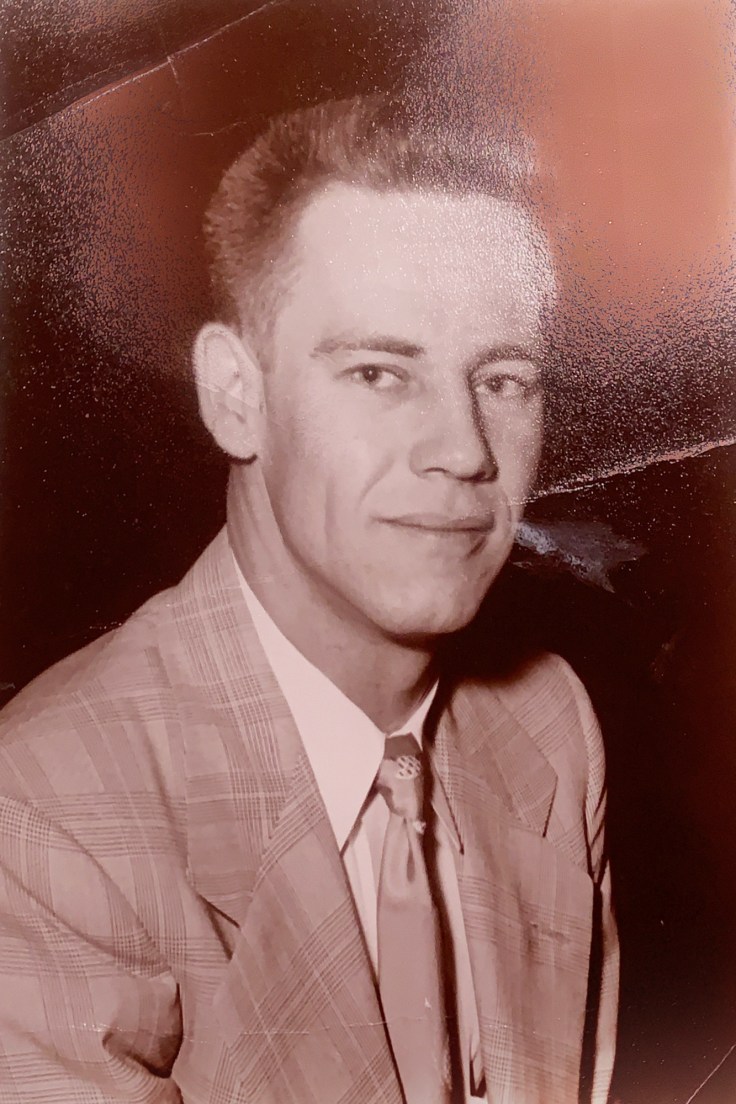
If you were to ask Dad what kind of man he was, he would tell you that he was just an ordinary man, just a regular “Bob.” He would tell you that he never walked on the moon or flew fighter jets; he never pulled children out of burning buildings or scored game-winning touchdowns, and he would tell you that he certainly was never rich – just a regular guy.
So what do you say about an ordinary man?
I would call to mind the time when I was eleven and I wanted to quit my paper route. I went to him while he was sitting at the dining room table with his checkbook open and a pile of bills in front of him. I had what I considered a good argument. I explained to him that I’d had the route for several months and it was just fine in the spring and summertime. The papers weren’t too heavy, the weather was nice, and my customers paid on time. But now it was December. It was cold and snowy, the holiday papers were twice as heavy, and many of my customers were trying to avoid payment. It was obviously time to quit.
My argument was undebatable, and Dad did not debate me. As he signed a check to the family dentist, he looked over his reading glasses and said, “It’s hard now but it will get better. You took the route and you’re not quitting it.” I was stunned! “I can’t believe he doesn’t understand,” I thought. But he understood.
Dad was never a quitter and he wasn’t about to let me become one. When things got hard, his resolve got harder. He worked two jobs to support a family of nine. He retired from a job he had held for 34 years, he lived to see his 50th wedding anniversary. And, over the last few years when his bank of doctors would repeatedly declare that his demise was imminent, he would repeatedly fight to prove them wrong. No matter the odds stacked against him, Dad was never a quitter. He didn’t know the meaning of the word.
And he taught me to be like him.
I remember the time I was a freshman in high school and Dad was actually able to attend one of my track meets. I had played football and run track that year, but because he was working two jobs, Dad had never been able to attend. This was the last track meet of the year, the city championships, and I was running the second leg for the 4 x 220 relay team. The crowd was huge by track meet standards, and for the first time my dad was one of them.
I was more nervous than usual as I stood waiting to receive the baton from our first runner. The exchange went smoothly, but we were already behind. I ran my best, but made no gain on the competition. As I approached the next exchange zone in front of the grandstand, our number three runner became agitated and began his take-off too early. I dug hard into the cinder track but saw instantly that there was no way I could catch him. Having been taught not to be a quitter, I did the only thing I could do to salvage the race. Running full bore, I left my feet and lunged forward in a head first dive, tossing the baton at my partner’s outstretched hand. The baton tumbled through the air, bounced off of his hand, and fell harmlessly to the track.
I hit the track in a full layout belly-flop and skidded across the cinders to a stop. Suddenly a huge roar went up from the crowd. I looked up and saw a grandstand full of people pointing at me and roaring with laughter. I was devastated. I was a laughing stock, and my father was there to see it.
My hands, thighs and chest were bleeding from the areas where the coarse cinders had torn my flesh. I tried to brush the cinders off but they were embedded deeply into my skin. I guess it hurt, but I didn’t notice. The only pain I felt was the pain of humiliating failure right in front of my father.
I was finished competing for the day but I could not go up and face him. I walked slowly around the track, wanting to disappear – to fade out of sight and never be heard from again. I finally made the long walk up the grandstand steps to face Dad.
He didn’t say a word. He smiled at me with that familiar twinkle in his eye that spoke volumes. He winked, and I knew everything was okay. I realized then that Dad’s love for me – for all of us – was unconditional. There were no strings attached; he loved us no matter what we did.
And he taught me to be like him.
And then, when I was seventeen, there was “The Incident” (my family knows what this is). Without going into details, it would be accurate to say that I screwed up big time and did something I shouldn’t have done. This was one of the few documented times that any of us saw Dad get really angry.
The next morning I knew I had to face the music, and Dad would be playing the tune. I expected a confrontation and, though I knew I had done wrong, I was also certain that I would end up answering his wrath with my own pent up anger. The Vietnam War was raging and I knew that I could be going straight from high school to the battlefront in a conflict that seemed to have no end. Life seemed so confusing and uncertain to a 17-year-old boy. Dad could not possibly understand – but he did.
The Apostle Paul wrote in Ephesians 6:4, “Fathers, provoke not your children to anger.” Whenever I read that I think of this time. My dad spoke to me in words that were firm and yet kind. He had turned seventeen with a world at war and an uncertain future. He knew all of my emotions. He dealt with me with wisdom acquired as a member of what Tom Brokaw has called “The Greatest Generation.” His gentle wisdom and firm discipline guided his children to adulthood, and provided the pattern for us to raise his grandchildren in the same manner…
Teaching us to be like him.
Dad – we will miss the twinkle in your eye when you smile, and the winks you gave that were worth a thousand words. There was the wink you gave Mom when, after you were dating for a while, you showed up with another girl. The wink you gave your daughters before walking them down the aisle. The wink you gave Katie when she was six and visited you after your first heart surgery to let her know you were okay.
Dad – I know you would call yourself an ordinary guy, but I would have to disagree. You were one-of-a-kind, our hero, and indeed most extraordinary…
And I hope that I can be like you.
GEORGE ROBERT SHAWHAN 7/17/27 – 1/4/03
Reprinted from a eulogy given on January 7, 2003 at St Marks Catholic Church, Peoria, IL.
 Unassailable Gospel
Leave a comment